

 4 MIN READ
33 LIKES
Why Is ‘Polly’ Short for Mary?
Whether you go by Dick, Peggy, or Chuck, nicknames don’t always line up with a full name. Let’s look at how some odd monikers became so popular.

by Bennett Kleinman
Share


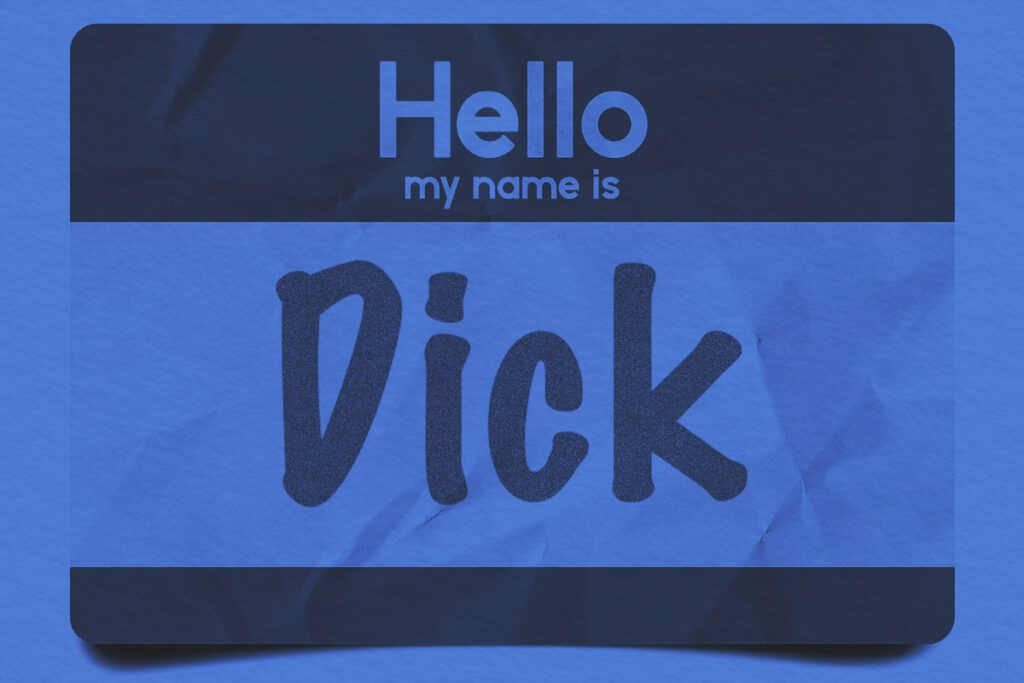
The name Richard doesn’t seem to have much in common with the nickname Dick, and yet the latter is still widely used as a shortened version of the former. This is just one of many cases where a full name is shortened to a seemingly peculiar abbreviation. We’re talking about Johns who go by Jack, Margarets known as Peggy, and Marys who are called Polly.

javascript:false
javascript:false
javascript:false
javascript:false
While these nicknames may seem odd based on their spelling, there’s a logical origin story behind many of them. During the Middle Ages, it was a popular practice to shorten names and swap certain letters, resulting in a playful rhyming nickname. Here are several examples of this phenomenon, and some other curious nickname origin stories that follow completely different trajectories.
Dick (Richard)
The name Richard was among the most popular male names in medieval England. In fact, it was so common that scribes came up with several shorthand versions, including Rich and Rick, to save time and effort while writing. Then, in the early 13th century, the trend of rhyming sobriquets emerged. This produced nicknames such as Hitch, Hick, and, of course, Dick. While most of these rhymes have faded in terms of widespread use, the name Dick has experienced lasting popularity.
Bill (William)
Deriving the nickname Bill from William is another example of this playful medieval naming mechanism. It follows the same logic as above — William was shortened to Will, and in time, people rhymed it with Bill.
Peggy (Margaret)
Margaret was among the most popular female names in the Middle Ages, and it needed a playful nickname. Diminutive monikers such as Margot, Magge, Magot, Mog, and Meg soon appeared, and the latter two examples followed the rhyming shift that was popular at the time, giving us Pog and Peg. Sometimes a “-y” was tacked onto the nickname, giving us Poggy (not so common today) and Peggy, which was quite common in the mid-20th century.
Advertisement
Polly (Mary)
Centuries ago, the nickname Mally was a common shorthand for people born Mary, but it largely fell out of use by the mid-18th century. Molly as a nickname for Mary also died out by the end of the 18th century, though it remains a common baby name on its own. But from Molly we got the rhyming moniker Polly, and that somehow stuck around long after Mally and Molly.
Jack (John)
The shift from John to Jack is yet another example of medieval nicknames with lasting appeal. In the Middle Ages, John — an extremely popular male name — was made into nicknames such as Johnkin, Jankin, and Jackin. Eventually, Jackin was shortened to simply Jack, which has maintained its popularity all these years later.
Sasha (Alexander)
Disconnected nicknames aren’t only an English-language phenomenon. In Russian culture, Sasha is a common nickname for Alexander (or the Russian equivalent Aleksandr). When it comes to Russian nicknames, it’s common to add “–sha” as a diminutive suffix. Take Aleksandr, shorten it to Sandr, and then replace the final few letters with the “–sha” suffix, resulting in Sasha.
Pepe (José)
The name José is the Spanish version of the English name Joseph. The original version was Josepe, which was shortened to José over time. This explains, in part, why Pepe is a common nickname for people named José. It’s an abbreviation of the old name José comes from, taking the end portion and doubling it.
Advertisement
Kit (Christopher)
You may be surprised to learn that Game of Thrones actor Kit Harington’s birth name is Christopher. It’s not as common a nickname today as it was centuries ago, but Kit is indeed a sobriquet for the given name Christopher. Meaning “bearing Christ,” this name is an abbreviated form of the first portion of Christopher, taking out three letters and changing the “C” to a “K” for a more prominent starting sound.
Featured image credit: © psdgraphics/stock.adobe.com
Advertisement

What Did People Do Before Eyeglasses?
Advertisement
6 MIN READ
33 LIKES
14 Words That Describe Words
English has a word for almost everything — including the weird and wonderful things that words themselves can do.

by Jennifer Wood
Share


Words can do just about anything. Not only do they define feelings, actions, ideas, and everyday things, but they also can describe people’s personalities, reveal where you’re from, and even give a name to your doctor’s messy handwriting.
But some words have a more meta job: They describe other words. English has a surprisingly rich vocabulary for doing just that — one that captures the tricks, quirks, accidents, and downright oddities that make language so much fun. Here are 14 of them.
Mondegreen
If you’ve ever heard Jimi Hendrix sing, “’Scuse me while I kiss this guy,” you’ve experienced a mondegreen — a misheard word or phrase, especially in song lyrics. (Jimi actually sang, “’Scuse me while I kiss the sky,” in the 1967 hit “Purple Haze.”) The term “mondegreen” came from a similar mishearing: Writer Sylvia Wright thought she heard the name “Lady Mondegreen” in a Scottish ballad where the actual words were “laid him on the green.” She officially coined the term “mondegreen” in 1954.
Eponym
You know that people can have sandwiches named after them (see: the Reuben), but did you know that “sandwich” itself is named after a person? (That would be John Montagu, the 4th Earl of Sandwich.) This makes it an eponym, or a word that comes from a (real or fictional) person’s name. “Boycott,” which comes from Charles Boycott, a 19th-century English land agent who became the target of a famous campaign of social ostracism, is another example.
Neologism
Before a word officially becomes a word, it can be a neologism, or a newly coined term created to describe something genuinely new or as a bit of wordplay. “Blog,” “selfie,” and “doomscrolling” all began their lives as neologisms. The term itself, which derives from the French néologie, meaning “the coining of new words,” is much older; its first known use was in 1754.
Advertisement
Retronym
A retronym is a type of neologism where a new word or phrase is created to distinguish an older version of something from its newer model. “Acoustic guitar,” for example, became a useful retronym after the invention of the electric guitar. Similarly, terms such as “snail mail” and “landline” emerged to distinguish older technologies from their newer counterparts.
Portmanteau
A portmanteau is a word formed by blending parts of two or more other words, combining their sounds or spellings — and usually their meanings, too. “Brunch,” for example, combines “breakfast” and “lunch.” We have Lewis Carroll to thank for “portmanteau”; it comes from Through the Looking-Glass, where the word, a play on an old term for “suitcase,” is used to describe a word packed with two meanings.
Backronym
A backronym is an existing word, phrase, or name that’s later turned into an acronym — an abbreviation formed from the initial letters of a series of words — through the invention of a phrase to fit its letters. For example, SAD, or seasonal affective disorder — a type of depression that typically occurs in the fall and winter months and is triggered by fewer daylight hours — was given the name so that the acronym would be appropriate for the disorder. “Backronym,” a portmanteau of “back” and “acronym,” first appeared in 1983 in The Washington Post, when columnist Bob Levey asked readers to submit their best neologisms. He credited it as “the brainchild of Meredith G. Williams of Potomac” and defined it as the “same as an ‘acronym,’ except that the words were chosen to fit the letters.”
Advertisement
Ghost Word
The scariest thing about a ghost word, a term that appears in a dictionary or other text but doesn’t actually exist in the lexicon, is that it typically got there because of a typo, transcription error, or misunderstanding (oh, the horror!). “Dord,” which appeared in the second edition of Webster’s New International Dictionary for years before editors realized it was a mistake caused by a notation being misread as a word, is one famous example.
Eggcorn
An eggcorn is a mistaken version of a word or phrase that sounds like the original but makes its own kind of sense. For example, “for all intensive purposes” is an eggcorn for “for all intents and purposes”: It’s wrong, but it plausibly could work. The term “eggcorn,” coined by linguist Geoffrey Pullum, comes from someone mishearing “acorn.”
Malapropism
Similar to an eggcorn, a malapropism is the accidental use of a word that sounds similar to the one intended but has a wildly different meaning. One famous example comes from former President George W. Bush during a 2000 campaign speech, when he declared, “We cannot let terrorists and rogue nations hold this nation hostile or hold our allies hostile.” (He meant “hostage,” not “hostile.”) Though its first known use was in 1826, “malapropism” comes from Mrs. Malaprop, a character in Richard Brinsley Sheridan’s 1775 play The Rivals, who had a memorable habit of making such verbal blunders as describing someone as “the pineapple of politeness” instead of “the pinnacle of politeness.”
Advertisement
Spoonerism
Rev. Dr. William Archibald Spooner, an Oxford dean and lecturer, was a noted scholar but reportedly prone to regular verbal mix-ups — so much so that the accidental switching of sounds between two or more words, resulting in a funny new phrase, became known as a spoonerism. Saying “blushing crow” instead of “crushing blow” is one of the most famous examples attributed to him.
Contronym
A contronym is a word with two meanings that contradict each other. “Sanction,” for example, can mean either “to approve something” or “to impose a penalty,” while “cleave” can mean “to split apart” or “to cling together.” These linguistic double agents have multiple names, including “autoantonym,” “antagonym,” or “Janus word,” a reference to the Roman god Janus, who was traditionally depicted with two faces looking in opposite directions.
Heteronym
If you’re prone to spelling mistakes, a heteronym has probably been to blame at least once. Derived from Greek roots meaning “different name,” “heteronym” refers to a word that’s spelled the same as another word but pronounced differently and with a different meaning. For example, “lead” can refer to the metal when pronounced “led,” or to guiding someone when pronounced “leed.”
Homograph
“Lead” is also a homograph, which is a broader term for words that are spelled alike but differ in meaning, pronunciation, or both. Not all homographs are heteronyms, though: “Bear,” for example, is spelled and pronounced the same whether it means the animal or “to endure something.” (To be a heteronym, the noun and the verb would be pronounced differently.) The term comes from Greek roots meaning “same writing.”
Advertisemen
Nonce Word
If you love Lewis Carroll’s 1871 poem “Jabberwocky,” you’re a fan of nonce words. These are words invented for a very specific occasion or context and that are not meant to become a permanent part of the language — though some do catch on. The term comes from the phrase “for the nonce,” meaning “for the particular occasion,” so a nonce word is quite literally a word made for the moment. “Chortle,” a chuckle-snort combo, is one of Carroll’s nonce words that has stuck around.
Featured image credit: © Stev3 Cassar/Pexels.com
Advertisement